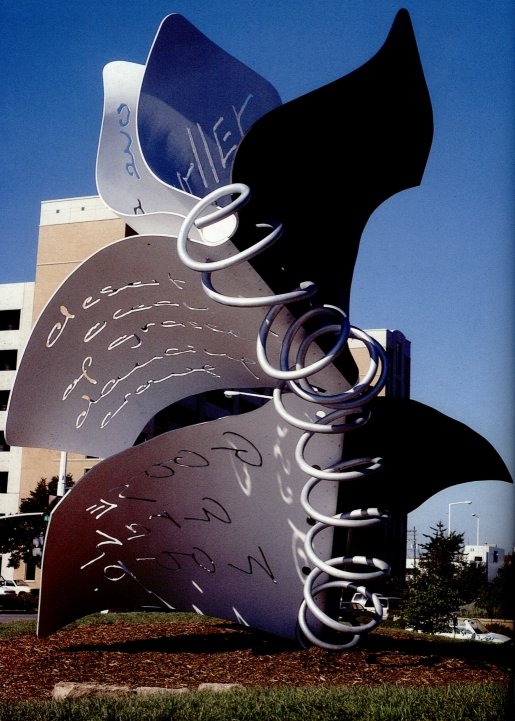
It was probably five years ago when I first encountered the “Torn Notebook” statue. Back then at about the age of thirteen, all I saw was a huge chunk of metal sculpted in the shape of a notebook. I saw no words written on the pages, or papers blowing in the wind, or any of the other meanings of the sculpture. In my naivety, I thought it was a rather asinine thing to build a big notebook. All I could ask myself was “Why? What’s the point?”

Over the years, after seeing it from time to time when visiting
Lincoln on shopping trips or for Husker games, I became more and more acquainted with this statue and as I became more sophisticated I began to see it in a new light. I still didn’t comprehend its meaning or purpose, but I started to appreciate the beauty of its movement and craftsmanship. Now, living in Lincoln as a student at Nebraska Wesleyan University, I figure its time to revisit this ambiguous work of art, and attempt to grasp its meanings. I realized that the “Torn Notebook” challenges viewers to look beyond the contents of its pages at the unwritten messages it is trying to portray.
Reaching upwards about twenty feet, this monstrous notebook attracts much attention from the downtown population of Lincoln. Of course, this notebook is no ordinary notebook made of paper. Instead, it’s constructed of aluminum and steel, painted with white for the pages, black for the cover, and silver for the spiral binding. The main notebook is torn down the middle and two other pieces of the statue are scattered in front, as if being blown away by the torturous Nebraska winds.

The sculptors,
Claes Oldenburg and
Coosje van Bruggen, were inspired to create this masterpiece, which represented their personal artistic style and process, because they always carry small spiral-bound notebooks wherever they go, so the subject matter was very appropriate. Their other source of inspiration was the state of
Nebraska, itself. The statue reflects the two artist’s impression and the respect they gained for the Nebraska community. The statue truly encompasses all the components of Nebraska into one masterpiece.
Located at the edge of the University of Nebraska-Lincoln’s campus and downtown Lincoln and as part of the
Sheldon Art Gallery collection, the statue is a symbol of the education and wisdom received at college. Thoughts, memories, ideas, and notes are a few of the things written in a notebook. The statue is like a big source of all of this knowledge and can be interpreted in many different ways. The torn pages of the notebook are like a representation of freedom. Because of its location at the edge of campus, I imagine a student mentally or physically tearing a notebook apart after the completion of college classes. This ‘ceremony’ marks the commencement of freedom to set out into the real world with all the knowledge gained from studying late at night from those now-torn notebooks.

The shape of the statue also helps with this idea of autonomy. The torn pages create four separate “wings” while the spiral forms the “body” creating the image of a butterfly. Butterflies stimulate a sense of freedom because of their movements and ability to fly. Just as butterflies drift with the wind, going where they please, a college student also drifts along not knowing which path to take. But eventually the butterfly finds a flower to land on, just as a college student ultimately finds his/her place in the world.
Along with the aspect of freedom created by the “Torn Notebook”, it also gives the viewer a feeling of what Nebraska is all about, not only naturally and physically, but also socially. Most obvious is the fact that the pages appear like they’re blowing in the wind, which is common for Nebraska. Another thing unique to this state is the prevalent tornadoes, which are represented in the statue by the twists and curves of the notebook’s spiral.
The words carved through the aluminum by way of water jet are written in a very flowing script. Coming straight from the notebooks carried by
Oldenburg and van Bruggen while visiting Nebraska, the words all have a particular meaning directed towards Nebraska. Some lyrical phrases include: “desert ocean of grass”, “dancing cranes”, and “in wayward winds swing henhouses”, which represent some of the sights seen by the Oldenburg and van Bruggen while visiting the state. Other descriptions noted were “wind”, “goose”, “clouds”, and some more obscure images. Some specific Lincoln descriptions in the text are “L-bow”, which refers to the sharp angle of the sower’s elbow on top of the
State Capitol building.
Nebraska Wesleyan University is even referred to by the word “Arch” on the notebooks pages, because of the arch at the entrance of campus. “Roller skate” is another one that appears because of the artist’s visit to the
National Museum of Roller Skating located in Lincoln. Even though there are obviously words on the pages, they are scribbled in such a way that at different angles it’s illegible and looks like jibberish. Also at different times of the day, the shadows cast by the statue and the cutout words create interesting shapes on the surrounding sidewalk. I think this adds to the degree of interpretation for different people.

The statue itself is very deceiving. First of all for the fact that it’s not actually a notebook. It’s not made of paper or anything natural. It’s constructed from man-made materials. With all of its implications towards the natural parts of Nebraska; such as, the wind, tornados, butterflies, etc., and the elegant flowing movement of the pages, you wouldn’t think of it as being made of aluminum and steel. However, this adds to the beauty and ambiguity of the piece. The word notebook has many connotations, and the fact that the statue looks like a notebook, even though it really is just a bunch of metal, makes the viewer think of all these different meanings and feelings that are generally associated with a real notebook. A few of the feelings evoked by the word notebook are related to intelligence, learning, turning a page in one’s life, and moving on to a different chapter in one’s life
The torn pages of the notebook also reflect a different type of movement. A movement of action that evokes feelings of anger, frustration, and/or confusion, because these are generally the reasons you think of for ripping a notebook in half. Movement is also shown in the way the pages are furling in the wind. This whole idea of movement relates not only to the natural world but also to the collegiate world. It is representational of college students’ transition from high school to college and finally to the real world. The notebook is a perfect symbol for this because a notebook is often associated with knowledge, which is what most students strive to attain while at college. These three transitional stages of mid to late adolescence into adulthood, I think are even further represented with the three pieces of the statue.
What feelings does a notebook spark in a person? A notebook is a place where the words flowing from your mind are captured on paper, making your thoughts, ideas, etc. visible to others. After people read these ideas, it evokes new or similar thoughts in their minds. The subsequent effect is that these ideas begin to flow from person to person and finally into society. Some words can cause people to jump into action and in some cases start a whole movement or riot. For example, when the Declaration of Independence was written, the words were so strong, powerful, and resonating in the hearts of the writers and their followers that it caused the creation of a whole new country and government, that we still follow, to this day.

This statue truly brings together and unifies many aspects of Nebraska by identifying various aspects of the state in one artistic movement. Even the two artists’ conception for the idea of the statue can be related to the movement of ideas from notebook to actualization. Not only are notebooks important to students, but they are also pertinent to the society as a whole. Without them there would be no movement.
After my revisit to the “Torn Notebook” and seeing all the college students with notebooks in hand and book bags in tow, I came to my senses and realized there is no inane part to this structure, even if my thirteen year old self had thought so the first time seeing its scattered pages. It has a true and meaningful message that hopefully all Nebraskans and visitors understand. I know this artwork will bedazzle, and perhaps stupefy many generations to come, but that’s the point of art, right? To let people’s imaginations run wild and allow them to form their own interpretations and perhaps jot them down in a notebook.
 important for Nebraska communities. According to “UNL wins $2.74M grant to improve literacy”, from the Lincoln Journal Star, this program teaches language and reading skills to rural, low-income children from ages three to five.
 important for Nebraska communities. According to “UNL wins $2.74M grant to improve literacy”, from the Lincoln Journal Star, this program teaches language and reading skills to rural, low-income children from ages three to five.